
The Myth of the Dream Roster
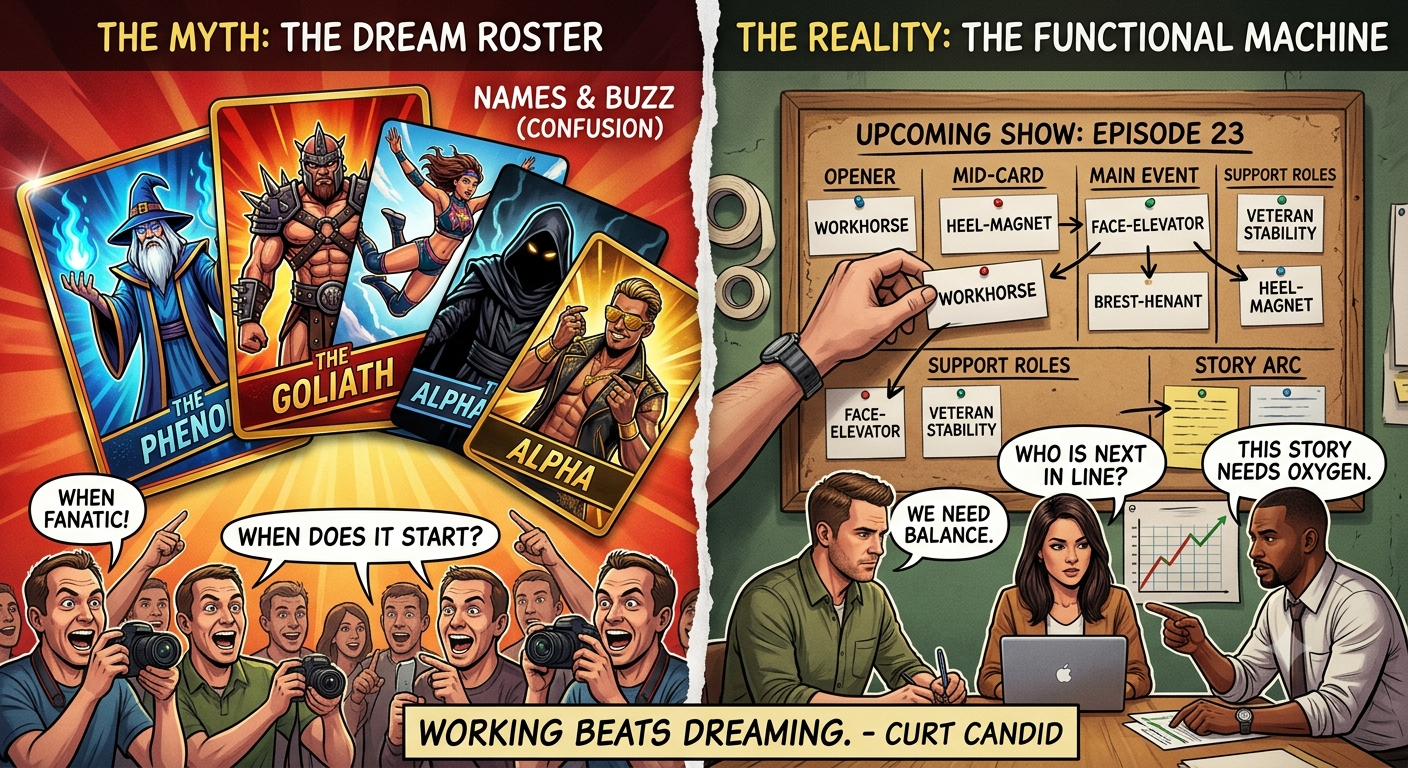
Every e-fed has at least one version of this fantasy at some point.
The dream roster.
The lineup that looks so good on paper it practically books itself. The names are all there. The star power. The buzz. The handlers everybody wants. The characters that sound like money. The kinds of people who make fedheads and readers alike start talking in excited, hypothetical sentences before a single angle has even been written.
And that’s the problem.
Because a dream roster is usually a fantasy built by people who don’t have to live with the consequences of being wrong.
It’s easy to fall in love with a collection of names. It’s much harder to build a functioning company around them.
That’s the part the scene keeps forgetting. Chemistry is not the same thing as talent density. A roster full of strong personalities is not automatically a strong product. In fact, if you stack enough “must-see” acts into the same space without structure, balance, or discipline, what you often get is not excellence but congestion.
Too many stars can choke the room.
That sentence will upset the people who still think wrestling is supposed to behave like a trading card game. Fine. Let it upset them. The truth usually does.
A fed is not a museum. It is not a trophy cabinet. It is not a place to collect the most prestigious names and assume the aura will do the rest. A fed is a living system. It needs oxygen. It needs roles. It needs contrast. It needs people who can carry attention, people who can support attention, and people who make both of those things easier by knowing exactly where they fit in the shape of the whole.
That last part is what dream rosters never seem to account for.
Everybody wants the headline act. Everybody wants the top-tier promo monster. Everybody wants the legend, the phenom, the future star, the once-in-a-generation character, the person who can pop a board just by logging in.
And if you somehow get all of them in one place, congratulations — you’ve also created a brand-new set of problems.
Who gets protected?
Who gets frustrated?
Who starts waiting for the spotlight instead of helping build it?
Who begins to feel like they are doing great work in a room that has no actual space for great work to breathe?
Those are not small questions. Those are the questions that decide whether a fed becomes sustainable or just impressive for six weeks.
Because the truth is, most dream rosters are built on ego, not architecture.
They are built by people imagining how cool it would be to say those names all belong to them. They are not built by people asking whether those names can actually function together without the whole thing becoming a traffic jam of self-importance and unbalanced expectations.
And I get it. I really do.
It is fun to imagine a roster where every character feels like an event. It is fun to imagine a show where every segment is must-see. It is fun to imagine a world where the card is so stacked that nobody has to worry about carrying anything because everyone is already carrying themselves.
But that’s not how the best feds work.
The best feds usually look a little less glamorous from ten feet away and a lot more coherent up close.
They have a midcard that matters.
They have supporting characters who know how to lose without disappearing.
They have talent who understand that making someone else look good is not a demotion, it is infrastructure.
They have a balance between oxygen thieves and oxygen providers.
They have room for a storyline to build instead of having every idea forced to peak immediately because everybody in the room believes they are the peak.
That is what separates a roster from a machine.
A dream roster is all heat.
A real roster has temperature control.
And yes, there’s a difference.
A roster should not be a random pile of “best case scenario” names. It should be an ecosystem. Some acts are there to anchor. Some are there to elevate. Some are there to create friction. Some are there to bring contrast. Some are there because they make the whole operation feel like a place where stories can actually happen instead of a highlight reel waiting for a caption.
When people skip that and just chase the most impressive possible paper lineup, they usually end up with one of two things:
A fed where everyone is important and therefore nobody is.
Or a fed where the few truly hot acts are trapped in a holding pattern because the structure around them never got built.
Neither is ideal.
Both are avoidable.
But avoiding them requires a kind of humility that the dream roster fantasy does not naturally encourage.
It requires admitting that not every great character belongs in every great fed.
It requires admitting that “perfect on paper” can be the enemy of “healthy in practice.”
It requires admitting that a strong scene needs support beams, not just fireworks.
And that is where the fantasy dies for a lot of people.
Because support work does not get the same applause as splash work.
The quiet steady hand does not generate the same excitement as the big name signing.
The character who always fills the right role does not always get the same recognition as the one who can dominate a board with one paragraph.
The fedhead who builds for balance instead of buzz does not always get the same instant admiration as the one who announces a roster full of names everybody already knows.
But the balance-builder is usually the one still standing when the novelty wears off.
And that, more than anything, is the point.
A dream roster is a momentary thrill.
A balanced roster is a long-term bet.
And long-term bets are usually what this hobby rewards if people are willing to be patient enough to let them work.
That does not mean you avoid talent. It means you respect the difference between talent and fit.
That does not mean you underreach. It means you understand that every strong character needs a system that lets them matter.
That does not mean you settle. It means you stop pretending the most exciting version of the roster is automatically the best version of the company.
Because it usually isn’t.
In fact, some of the most memorable feds in this scene have not been the ones with the biggest names. They’ve been the ones where the right names were in the right places, doing the right jobs, with enough room for the product to breathe between the pressure points.
That’s not sexy.
That’s not glamorous.
That’s not the kind of thing people brag about in fantasy booking threads.
But it works.
And in this business, working beats dreaming every time.
So by all means, dream big.
Just don’t confuse a dream roster with a roster that can actually survive contact with reality.
The first one looks great in a post.
The second one builds a legacy.
Until next time,
Curt Candid


