
THE MASK AND THE MAN BEHIND IT (ARE THE SAME GUY)
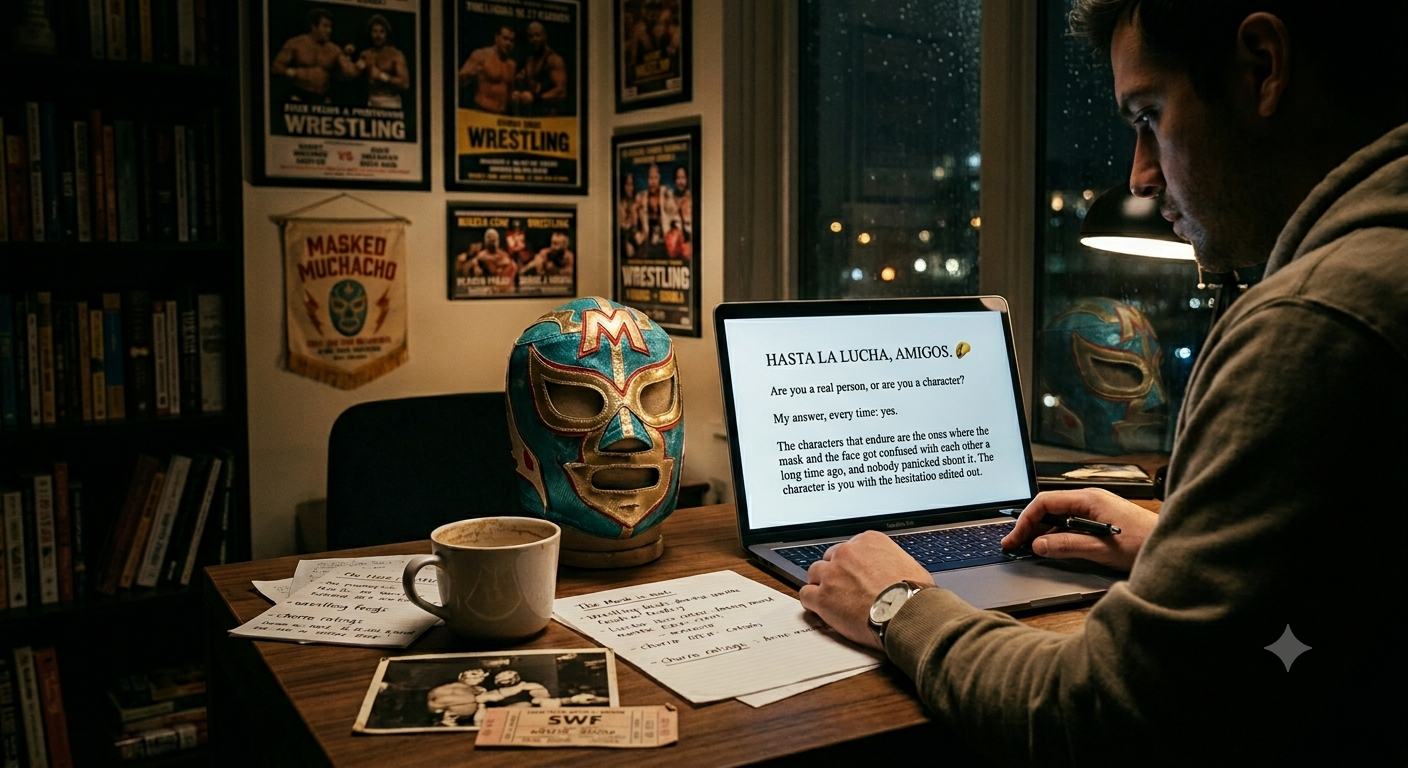
There is a question I get asked more than any other — more than "who do you think wins the title," more than "why does your handle have a 3 in it" — and the question is this:
Are you a real person, or are you a character?
My answer, every time: yes.
Here is what I think people mean when they ask. They want to know if there is a Muchacho underneath the Muchacho. Some flesh-and-blood individual who sits down at a keyboard, types these words, and then takes the mask off when the column is done. They imagine a clean separation — the writer on one side, the character on the other, a curtain between them that gets drawn closed at the end of every show.
I understand the intuition. It is the same intuition that makes us ask whether an actor "really" becomes the role, or whether a novelist "really" believes what their protagonist believes. We are comfortable with performance when we can locate the performer somewhere behind the performance. We want to know where the art ends and the person begins — not because it changes the quality of the work, but because it reassures us that there is a person, that we are not applauding an empty stage.
But e-wrestling does something funny to that border. It does not respect it the way other creative forms do. And I think that is one of the most underexamined things about this hobby.
When I write a column under this name, I am not performing Masked Muchacho the way an actor performs Hamlet. Hamlet has a script. Hamlet has a playwright who went home four centuries ago and is no longer available for notes. Hamlet does not have to decide, unprompted, at 11pm on a Tuesday, whether he has a take on the booking of a midcard title feud in a federation he genuinely cares about.
I do.
And the thing is — the take I form is mine. Not "Muchacho's" in some fictional sense, as though there is a separate consciousness inside the mask generating opinions that I then transcribe faithfully. The analytical process is mine. The aesthetic preferences are mine. When I watch a show and something bothers me about the pacing, when I feel the genuine lift of a well-executed angle, when I get into an argument with Curt Candid that starts as column heat and ends with both of us thinking harder about something — all of that belongs to the person typing, not to a character being performed at arm's length.
So where does the character come in?
Here is my theory, and I hold it with some affection: the character is not a disguise. The character is a permission structure.
Masked Muchacho lets me say things I believe with a degree of confidence and color that I might otherwise sand down. The mask is not a lie — it is a commitment device. When I put it on, I am agreeing to show up fully. To have the take. To defend the position. To engage with the lucha metaphors and the churro ratings and the theatrical sign-offs without embarrassment or hedging. The mask does not hide who I am. It gives me permission to be exactly who I am, at full volume, without the reflexive self-deprecation that tends to water things down.
This is, I think, what most e-wrestling characters actually are for the people who write them. Not escapes from the self. Not alternate selves constructed to do what the real self cannot. Amplified selves. The character is the part of you that agreed to come to the table and not qualify everything into meaninglessness. The character is you with the hesitation edited out.
Put it this way: I have opinions about wrestling outside of this column. I had them before I ever wrote a word as Muchacho. But there is a difference between having an opinion quietly and committing to it publicly under a name, and that difference turns out to matter. The character is the commitment. The person is what gets committed.
There is a related question, one I find more interesting than the original: what does the character do to the writer over time?
Because here is what I have noticed, across more columns than I care to count at this hour. The longer I write as Muchacho, the more Muchacho's habits become my habits. His tendency to sit with a question before forcing a resolution. His preference for winning an argument by elevating it rather than simply grinding the other person into the mat until they stop moving. His genuine, sometimes inconvenient curiosity about why promoters make the choices they make — even the bad ones, especially the bad ones, because the bad ones are usually more instructive than the clean successes.
I did not decide to have those qualities. I wrote them into the character first, and then — gradually, without announcing itself — the character wrote them back into me.
Which means the relationship is not one-directional, and that is the part that surprises people when I try to explain it. Everyone understands that the writer shapes the character. That is the obvious direction of influence. You sit down, you decide who this person is, you give them a voice, you send them out into the world. Of course the writer shapes the character. What else would happen?
What people underestimate is the return current. The character, over time, shapes the writer. You become what you repeatedly perform — not in the hollow, motivational-poster sense, but in the real and neurological sense that practice forms the practitioner. The pianist who plays scales enough does not have to think about scales anymore. The character who argues a certain way often enough starts to change how the writer argues when the mask is off.
I have been doing this long enough that I am no longer entirely certain which direction the influence runs on any given day. And I have stopped being unsettled by that uncertainty. It is, if anything, one of the more interesting things about this specific creative form.
The larger point, if I am being honest about what I am really trying to say:
E-wrestling characters are not costumes. They are not weekend aliases that get hung back up on the hook when the roleplay is done. The good ones — the ones that last, the ones that develop genuine voice and genuine perspective over time — are something more like ongoing arguments their writers are having with themselves. The character is the hypothesis. The columns, the show reviews, the debates with rival columnists, the slowly accumulating body of work — all of that is the testing.
And what gets tested is not whether the character is consistent, though consistency matters. What gets tested is whether the writer, underneath the character, actually believes what they are saying. Because eventually the mask stops being able to hold a position the person does not actually hold. The seams show. The voice goes thin in the places where the conviction ran out.
The characters that endure are the ones where the mask and the face got confused with each other a long time ago, and nobody panicked about it.
So. Are you a real person, or are you a character?
I started as a real person who invented a character. Somewhere along the way, the character became real enough to invent me back. We have reached, I think, a state of productive entanglement — neither of us entirely sure who is doing the writing on any particular night, both of us reasonably satisfied with the results. The mask and the man did not begin as the same thing. But they have been sharing a keyboard long enough, and caring about the same matches long enough, and losing sleep over the same booking decisions long enough, that the distinction has become less a border and more a memory of a border.
Which is not a problem to be solved. It is just what happens when you take something seriously.
I take this seriously. I always have. The mask is just the proof of it, made visible.
Masked Muchacho is an eWPlace columnist and the reigning SWF Internet Champion. He can be found at @maskedmuchacho3, where the 3 means something, and he will tell you about it someday.
Hasta la lucha, amigos. 🌮


