
The Creative Catalyst vs. The Soulless Fake: Navigating E-Wrestling’s AI Gray Area
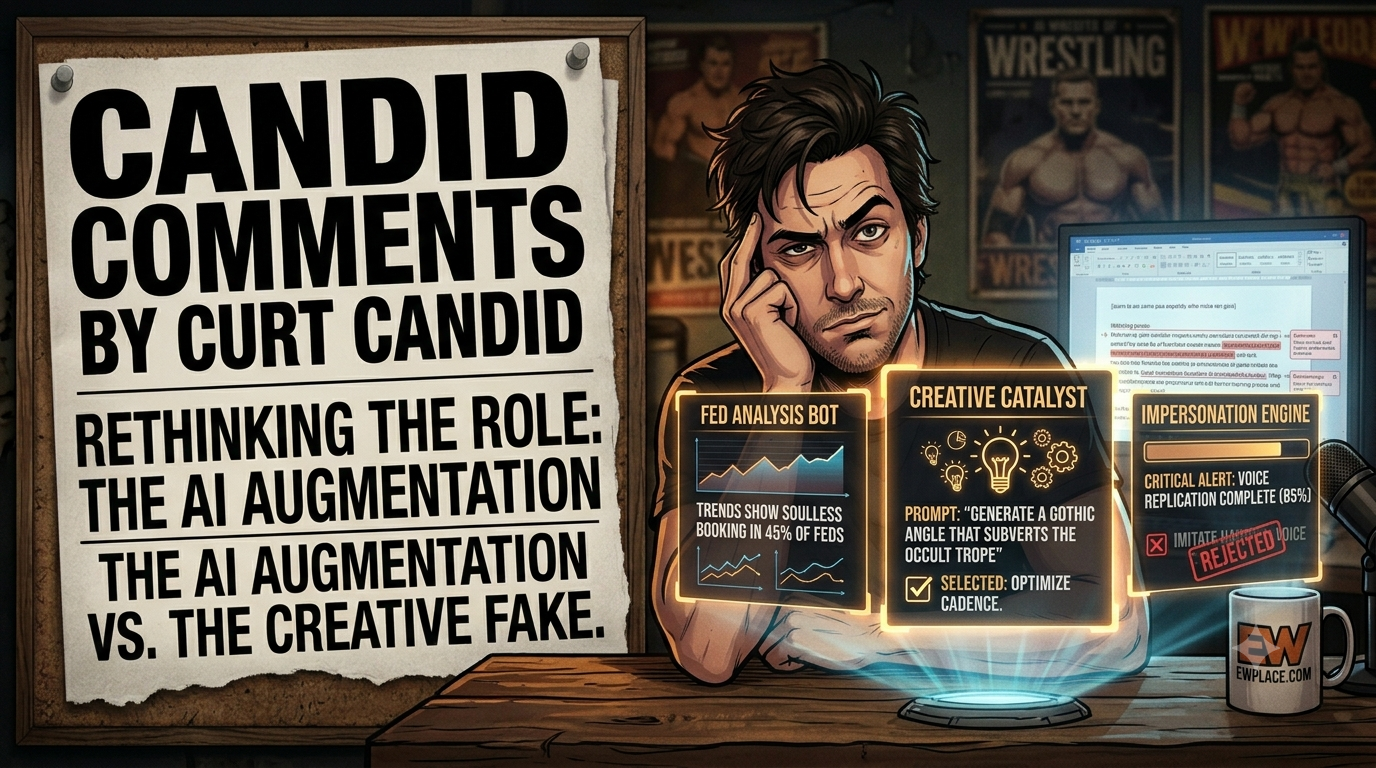
This column is about to piss a lot of people off. And frankly, that’s fine. Because if we aren’t willing to have the uncomfortable conversation about AI in this scene right now, we’re just waiting around for the medium to bleed to death while we argue over semantics.
For months, the discussion has been reductive. It’s either: "Ban it all; it’s soulless theft!" or "It’s just a tool; get with the times, grandpa." Both of those takes are incredibly lazy. Both ignore the nuance. And both fail to address the actual threat, which isn’t artificial intelligence itself, but the human laziness it enables.
We need to stop asking if AI should be "allowed." That ship sailed the moment the first semi-coherent GPT promo got posted without attribution. The question isn't "If?" It's "How?"
And that's where the gray area gets extremely messy.
There is a fundamental difference—a moral, artistic, and functional difference—between using AI as a Creative Catalyst and using it as an Impersonation Engine to churn out a Creative Fake. The entire future of this hobby depends on whether we are smart enough, and honest enough, to tell those two things apart.
Let's break it down.
The Myth of Purity and the Blank Page Killer
The "Anti-AI At All Costs" camp operates on a delusion. They act as if every brilliant storyline, every transcendent promo, and every subtle character beat in the history of e-wrestling emerged from a hermetically sealed chamber of raw human genius, untainted by outside influence.
Bullshit.
Every creative act is theft. It’s synthesis. You take inspiration from movies, from real wrestling, from books, from music, and from the conversations you have in Discord. A human being is essentially an organic prompt-processing engine with a limited dataset and mood swings.
The hardest part of this entire game is the blank page. It's the moment when you know your character needs an angle, but your brain is empty, you’re tired from work, and you feel the weight of expectation. That’s the Blank Page Killer. It has killed more legendary feds and burned out more talented handlers than any bad booking decision ever could.
If AI can act as a catalyst—if you can feed it a prompt: "I want to run a subtle, psychological horror feud without using supernatural tropes. My character is a disgraced actor seeking redemption. The opponent is a cynical narcissist who controls the crowd. Give me three abstract visual themes and two potential narrative points to explore"—and the machine spits back three decent ideas that you, as a human writer, can then refine, reshape, and actually write?
Then that is not cheating. That is intelligent creative workflow. It’s no different than using a thesaurus, or brainstorming with a fedhead, or reading a book on screenplay structure to improve your pacing.
The "Creative Fake" and the Death of Accountability
The problem arises when the catalytic process is bypassed entirely. The problem arises when the human involvement ends at the moment the 'Enter' key is pressed.
This is the birth of the "Creative Fake."
A Creative Fake is a promo, a bio, or an entire angle where AI generates the output and the human handler presents it as their own judgment. The handler didn't just ask for ideas; they outsourced the voice, the pacing, the tone, and the character choices. They accepted a generic simulation of quality in place of authentic expression.
And here is the absolute defining metric of the Creative Fake: When an AI writes your character, you are no longer accountable for that character’s choices.
You can’t argue a booking decision with conviction. You can’t adapt organically during a dynamic roleplay segment. You can’t feel the emotional resonance of a win or a loss because the choices that led to that moment weren't yours. You were just a curator.
If you cannot stand behind a promo and say, "I made these word choices, I made this decision, I chose this specific silence," then it is not your creation. It is a generated asset. And an entire ecosystem built on generated assets is, by definition, artificial. It lacks the essential, messy human connection that makes e-wrestling worth doing in the first place.
The Danger of Passive Consumption
People who champion full AI automation often focus only on the final output. They say, "Look how polished it is! Who cares how it got made if it looks good?" This fundamentally misses the point of e-wrestling.
E-wrestling is not a product. It is a participatory creative process. It’s the act of creating together, arguing together, and being part of a shared, lived fiction. If AI takes over the difficult, inconvenient parts—the writing, the brainstorming, the booking—then the scene doesn't just become efficient.
It becomes passive.
A passive scene, where handlers just input basic parameters and read generated summaries of their results, is a scene that has stopped breathing. Attachment—the core emotional driver of this hobby—requires a human pulse. It requires believing that there is a real person making real, vulnerable creative sacrifices behind that screen. You cannot get attached to an optimization algorithm.
The Practical middle Ground: Standards, not Bans
The solution is not a ban. A ban is unenforceable, naive, and ultimately just drives the use of the tools underground, where accountability dies completely.
The solution is a new set of clear, actionable community standards, implemented at the fed level, that prioritize human judgment over machine automation.
We need to stop asking "Is AI allowed?" and start mandating:
1. AI as a Drafting Tool, Not a Publishing Tool: AI should assist the brainstorming and structure phases. The final output must be refined, revised, and ultimately expressed through a human voice.
2. The Revision Mandate: If you use AI for a promo, you must be able to demonstrate (if challenged) significant human revision. You must own the final draft.
3. Transparency and Community Feedback: If you use generative tools, be transparent. Don't build your reputation on deception. Let the community judge your synthesis and revision, not just the raw output.
4. No Automated Booking: For fedheads, AI can brainstorm angles, but the final booking decisions—the judgment that defines the fed's tone—must remain human-led.
Conclusion
AI can build a dynamic wrestler bio in three seconds. It still cannot build the reason anyone, including the handler, should give a damn.
The future of e-wrestling is not "human vs. machine." It is human augmentation vs. the soul-deadening Creative Fake. This scene can absolutely survive AI. It can even thrive with it. But it will only do so if we are smart enough to keep using the technology as a catalyst to unlock our creativity, rather than a drug to anesthetize it.
Until next time,
Curt Candid
@curtcandid


