
The Loneliest Match Nobody Talked About
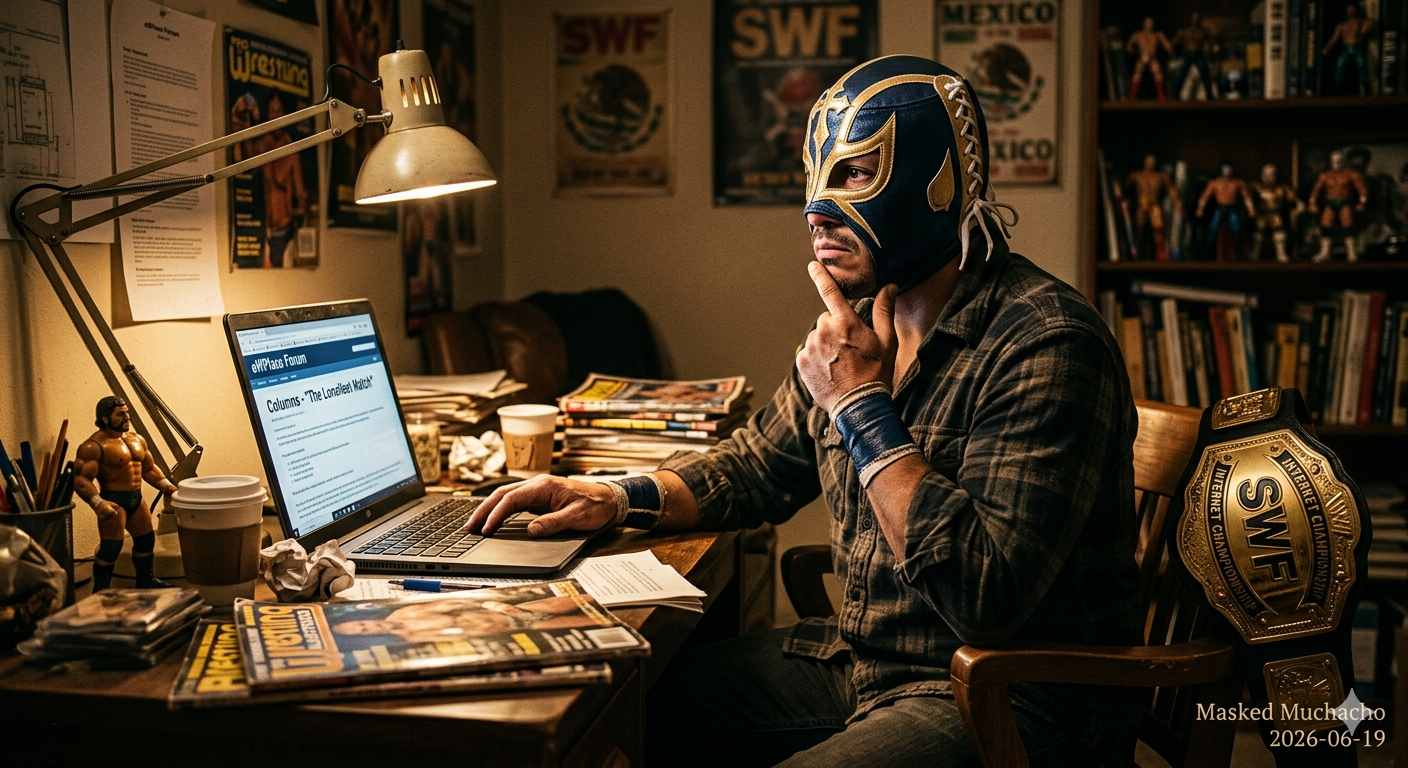
There was a match last week — I won't say where, I won't say who — that was genuinely excellent.
Clean work. Smart structure. The kind of pacing that makes you forget you're reading and just lets you feel the thing happen. A finish that earned what it was asking for. Two handlers who clearly talked, clearly cared, clearly put in the time to make something that held together from bell to bell.
And almost nobody mentioned it.
Not because people didn't see it. Some of them did. But the conversation had already moved somewhere else by the time the result posted, and the match just kind of sat there in the results thread like a very good meal at a restaurant that closed before the reviews came in. The chairs stacked. The lights off. The cook already home.
I think about that a lot more than I probably should.
But I think about a lot of things more than I probably should. That's what the mask is for. Nobody can tell.
The Attention Economy, And Why It Eats Its Own Cooking
This hobby has an attention economy problem that we don't talk about honestly very often. Not because people are malicious — most of them aren't — but because there are only so many hours and only so many eyeballs, and the stuff that gets discussed tends to be the stuff that's already being discussed.
Momentum attracts momentum. Conversation attracts conversation.
And here's the specific mechanism that makes it worse in e-wrestling versus almost any other creative hobby I can think of: the scene is small enough that a handful of voices can genuinely set the temperature for everyone else. When two or three people with reach start talking about something, it becomes the thing. When those same people are quiet about something, the silence has weight. It doesn't mean the thing is bad. It just means the right people weren't in the right mood on the right day to throw it into the current.
That's a fragile system to hang quality on.
It also creates a weird feedback loop where the feds and handlers who are already getting attention have more opportunities to generate the kind of moments that get more attention, while the ones operating outside that orbit have to work twice as hard to get half the notice. Not because the scene is rigged — I don't think it is, not intentionally — but because attention is a resource and resources flow toward where they've already been flowing.
The quieter corners of this scene, even when something remarkable is happening in them, have a harder time pulling focus than they used to. And the scene is bigger than it used to be, which means the quiet corners are more numerous and more distant from the center than ever before.
That's not an accusation. It's just the weather.
But weather still gets people wet if nobody mentions it's raining.
What "The Middle" Actually Looks Like (And Why It's Most Of This)
I want to talk about the middle for a minute, because I mentioned it in passing and it deserves better than a passing mention.
When people talk about e-wrestling — when they get excited about it, when they evangelize it to someone who's never tried it, when they write the kind of column that makes a newcomer want to sign up — they tend to talk about the peaks. The legendary angle. The promo that made people stop and read it twice. The match that the fed is still talking about three years later. The moment where everything clicked and the whole card felt like it was building toward something real.
Those things exist. They're wonderful. They're worth chasing.
But they are not the majority of the experience. Not even close.
The majority of the experience is the match that goes third on a Tuesday card that people read on their lunch break and then set down to go back to work. It's the promo that comes in clean and on time and does exactly what the storyline needs it to do without doing anything that would make a highlight reel. It's the tag team that's been slowly building chemistry for two months in matches that individually don't demand attention but collectively are constructing something that will eventually matter enormously.
It's the handler who takes the loss gracefully and writes it in a way that makes their character more interesting instead of less.
It's the fedhead who posts results on a Wednesday night to an audience of maybe fifteen active readers and does it anyway because the story deserves to be told even when the room is small.
That's the middle. That's most of this.
And here's what I've come to believe after however many years I've been doing this — enough years that I've stopped counting them publicly for reasons of personal vanity — the middle is where character actually forms. The peaks are where character gets revealed. But the middle is where it gets built, quietly, without applause, in the accumulated weight of a hundred small decisions about who this person is and how they move through the world.
The handlers who understand that are the ones worth watching long term. Not because they don't want the peaks — everyone wants the peaks — but because they respect the middle enough to do it right even when nobody's grading it.
That match I mentioned at the top? Third on the card. Tuesday. Fifteen readers, maybe. Two handlers who did it right anyway.
That's the middle. That's everything.
Why I Started Reviewing, Honestly
I should tell the truth about this because I haven't been entirely honest about it before.
I started writing reviews because I was bored.
That's the real reason. Everything else I've said about it — the act of attention as a form of value, the importance of the critical voice, the scene needing more honest outside perspectives — all of that is true, but it came second. The first thing was just: I had time, I had opinions, and I had a mask that gave me enough distance from my own ego to say things I might not have said under my real name.
The mask is useful that way. Anonymity isn't about hiding. It's about having a little room to be honest without your face getting in the way of the idea.
But somewhere in the process of just doing it — of showing up to cards I had no personal stake in and trying to describe what was happening as clearly and fairly as I could — I started to feel something I hadn't expected.
I started to feel like I was paying a debt.
Because I've been in this hobby long enough to remember being the handler whose work didn't get noticed. I remember posting in a fed where the results thread got three replies and two of them were from people in the fed. I remember the particular silence of a match you were proud of landing in a void. Not hostile. Not critical. Just... absent.
And I remember how much it would have meant — genuinely, materially meant — for someone outside the situation to show up and say: I read this. I was here for this. This was good.
That's all I'm trying to do when I write a review. I'm not trying to be the authority. I'm not trying to set the agenda. I'm just trying to be the person I wished existed when I was working in the quiet corner and wondering if any of it mattered.
It did. It does. Somebody should say so.
Turns out that somebody is a man in a mask with an Internet Championship and too much time on his hands.
The scene works in mysterious ways.
The Quiet Fed Problem, Specifically
Let me get concrete for a minute because I've been floating at altitude and it's time to land the plane.
There are feds running right now — active, consistent, putting out content on schedule — that a significant portion of this scene has never meaningfully engaged with. Not because they're bad. Some of them are quite good. But because they don't have the name recognition, the legacy roster, the pre-existing audience, or the champion handler who brings their own following through the door.
They're just running. Quietly. Doing the work.
And what happens to a fed like that in the current ecosystem is a specific kind of slow erosion that's hard to diagnose until it's already done damage. Handlers join with energy and then gradually notice that the external conversation never seems to find them. Results post and the silence outside the fed's own Discord is total. They start to wonder — quietly, then louder — whether they're building something or just maintaining something, and whether there's actually a difference at this point.
Some of those feds close. Some of them probably shouldn't have.
And the tragedy isn't that the scene is cruel. The scene isn't cruel. The tragedy is that the scene is just busy, and busy looks identical to indifferent from the outside, and indifferent is very hard to keep running shows for.
This is fixable. Not completely, not permanently, but meaningfully. And the fix is embarrassingly simple: go read something you didn't have a reason to read. Go find a card from a fed you've never engaged with and spend twenty minutes with it. Leave a reply in the results thread. Say something honest about what you saw.
You don't have to be a reviewer. You don't have to be eloquent. You don't have to have a persona with a mask and a title belt and a column on eWPlace.
You just have to show up.
The fed that gets one unexpected outside reply on a Tuesday night is a different fed than the one that gets zero. The handler who gets one "hey, that was a strong promo" from someone outside their own roster is a different handler than the one who gets nothing. The fedhead who knows someone is paying attention is a different fedhead than the one running on faith alone.
One reply. One comment. One person saying: I was here, I saw this, it counted.
The return on that investment is absurd. It costs almost nothing. It means almost everything.
What "Saying Something" Actually Means
I want to end on this because the ending of a column is where you find out whether the writer actually believed what they were saying or was just enjoying the sound of their own voice.
I believe this.
I believe the scene is better when more of its members feel seen by more of the people around them. I believe the work happening in the quiet corners is often as good as — and sometimes better than — the work happening at the center. I believe that attention, distributed a little more generously and a little more deliberately, would keep more good things alive longer.
And I believe that none of this requires a grand gesture or a structural overhaul or a scene-wide initiative with a logo and a Discord announcement.
It just requires a habit.
The habit of occasionally stopping the scroll and sitting with something that didn't demand your attention and giving it your attention anyway. The habit of saying the thing you thought when you read the match, even if what you thought was just "that was solid, I enjoyed it." The habit of treating the middle of this hobby with some of the same reverence you'd give to the peaks.
That match last week — the one nobody talked about, the one third on the card, the one that deserved better from the room — I'm glad I was there for it.
I hope someone told them.
If nobody did: hey. I saw it. It was good. You worked hard and it showed.
Come back next week.
We'll be here.
Hasta luego,
Masked Muchacho
SWF Internet Champion
Paying attention since before it was convenient, and intending to keep doing so


