
Could Interfeds Work in Modern Fantasy Wrestling?
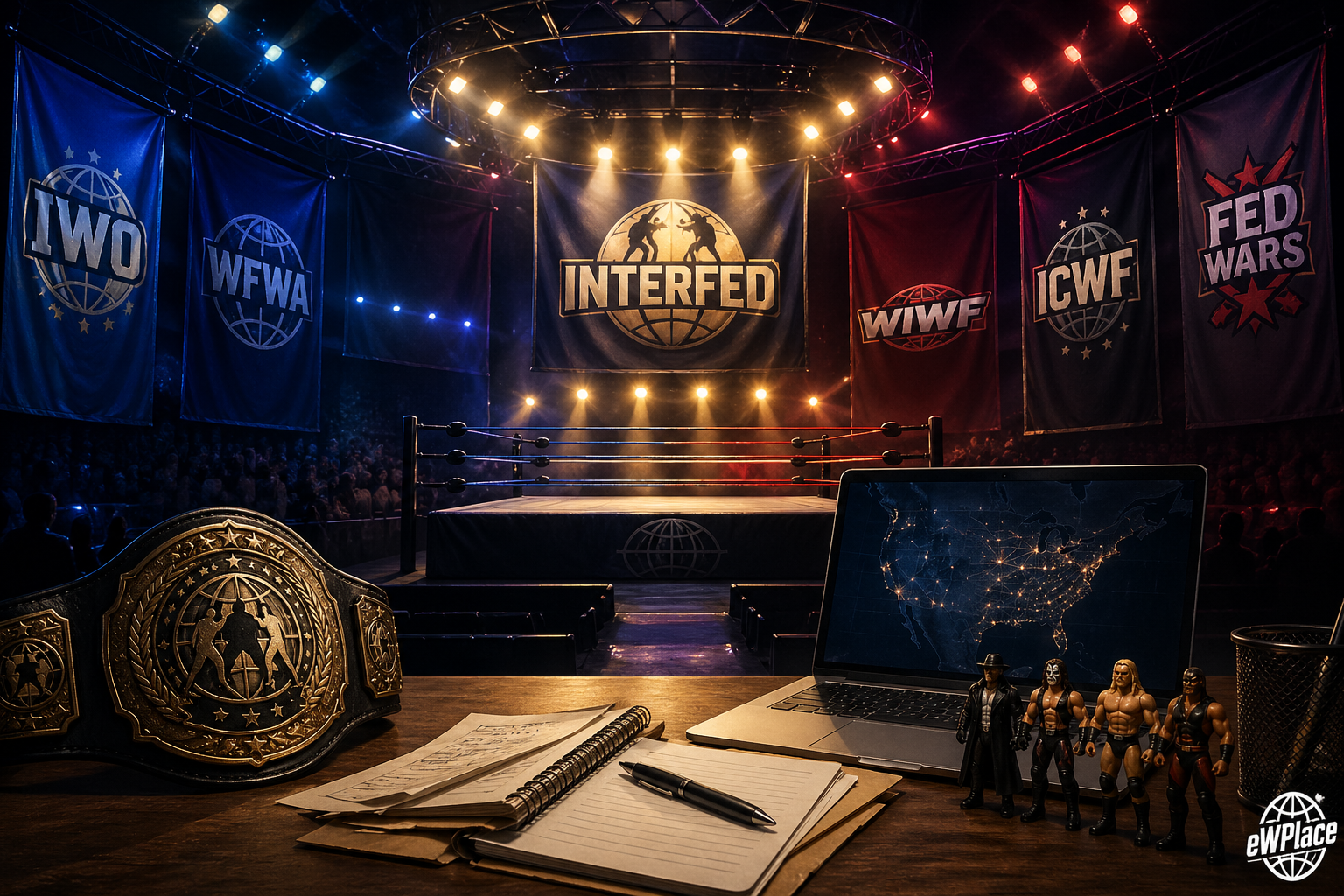
The old interfed dream was simple: take the best characters from different fantasy wrestling promotions, put them under one banner, and see who really stood above the rest. The modern question is harder: does that idea still fit the way fantasy wrestling is played today?
There was a time when interfeds felt like the natural next step for the hobby.
Fantasy wrestling grew out of play-by-mail, email, message boards, Usenet groups, and early websites. The hobby thrived on connection. Handlers moved from fed to fed. Reputations carried weight. A strong promo writer could become known across multiple communities. Fedheads didn’t just compete with their own roster—they competed for relevance across the wider scene.
Out of that environment came interfeds—organizations designed to unify, rank, and showcase the best of multiple promotions.
Some of the most notable included the Internet Wrestling Organization, the World Internet Wrestling Federation, the Primetime Central, and the World fantasy Wrestling Alliance. Alongside them were community-driven efforts like FedWars, which leaned heavily into competition and cross-fed bragging rights rather than centralized governance.
Each of these projects approached the concept differently. Some focused on rankings and championships. Others emphasized tournaments or seasonal competition. Some tried to act as governing bodies for the hobby, while others functioned more like battlegrounds where feds could test themselves against each other.
But they all shared one core idea: fantasy wrestling was bigger than any single fed.
In that older version of the game, interfeds worked because many feds spoke the same language. Characters were judged on promos, activity, storytelling, and consistency. Even if styles varied, the foundation was similar enough that cross-fed competition felt fair—or at least close enough to fair to be accepted.
That was the magic.
An interfed could turn local stars into global names within the hobby. It gave handlers something bigger to chase. It gave fedheads a promotional tool. It made everything feel connected. It made fantasy wrestling feel like a world.
But that same structure is exactly why interfeds struggle to exist in the same way today.
Interfeds only work when enough people agree on what the game is.
And today, the game is not one thing.
Modern fantasy wrestling is more diverse than it has ever been. Some feds are promo-driven. Some are angle-based. Some are fully written match feds. Some function like collaborative storytelling projects. Others resemble competitive systems with strict judging. Some prioritize realism. Others lean into cinematic or supernatural presentation. Some operate on forums, others on Discord, and some through fully custom-built platforms.
This diversity is a strength—but it breaks the old interfed model.
The classic interfed assumes a universal measuring stick. Who is the best? Which fed is strongest? Who deserves to be ranked number one?
But those questions don’t have universal answers anymore.
In one fed, the best character might be the strongest promo writer. In another, it might be the handler who contributes most to long-term storytelling. In another, it might be the best match writer. In another, wins and losses might not even be the point.
So when a modern interfed tries to declare a single hierarchy, it immediately runs into conflict.
Not because people disagree—but because they are playing fundamentally different versions of the same hobby.
That doesn’t mean interfeds can’t work.
It means they can’t work the same way.
The biggest mistake a modern interfed could make would be trying to recreate the past exactly. The hobby has evolved too far. Handlers are more protective of their characters. Fedheads are more protective of continuity. Stories are deeper. Worlds are more defined. A random loss or mischaracterization isn’t just a stat—it can disrupt months of storytelling.
So the modern interfed cannot be a governing body.
It has to be something else.
It has to be a network.
Instead of deciding who the best is, a modern interfed should focus on showcasing what exists. It should highlight promotions, feature characters, review shows, promote events, and connect audiences across different communities.
This is a fundamental shift—from authority to visibility.
The old interfed was about hierarchy.
The modern interfed should be about discovery.
Fantasy wrestling today doesn’t need a single world champion of the hobby. It needs better bridges between isolated groups. It needs a place where someone can see what’s happening outside their own fed without digging through forums or Discord servers. It needs a platform where shows can “air,” where results can be shared, and where the hobby feels active beyond individual sites.
That kind of interfed could absolutely work.
But only if it respects the realities of the modern game.
Participation must be opt-in. Canon must be protected. Rankings must be transparent. Differences between feds must be preserved, not flattened.
A modern interfed doesn’t need to tell every fed how to operate.
It needs to give every fed a stage.
The most realistic evolution of the concept might not even look like an interfed in the traditional sense. It might look like a broadcast network—a structured schedule where weekly shows “air” across a seven-day lineup. Some time slots are filled with new content. Others with replays. Each fed keeps full control of its identity, but gains visibility within a larger ecosystem.
That idea doesn’t replace the interfed concept.
It modernizes it.
Because the truth is, interfeds were never really about deciding who was best.
They were about making the hobby feel bigger.
And that goal still matters.
Maybe more now than ever.
So would interfeds work today?
The old version—where one organization tries to rank and govern the entire hobby—would struggle. The differences between feds are too large. The expectations are too different. The stakes are too personal.
But a modern version?
One built around visibility, connection, and shared presentation?
That doesn’t just work.
That might be exactly what the hobby has been missing.


