
The Illusion of Competition: Are We Still Playing the Same Game?
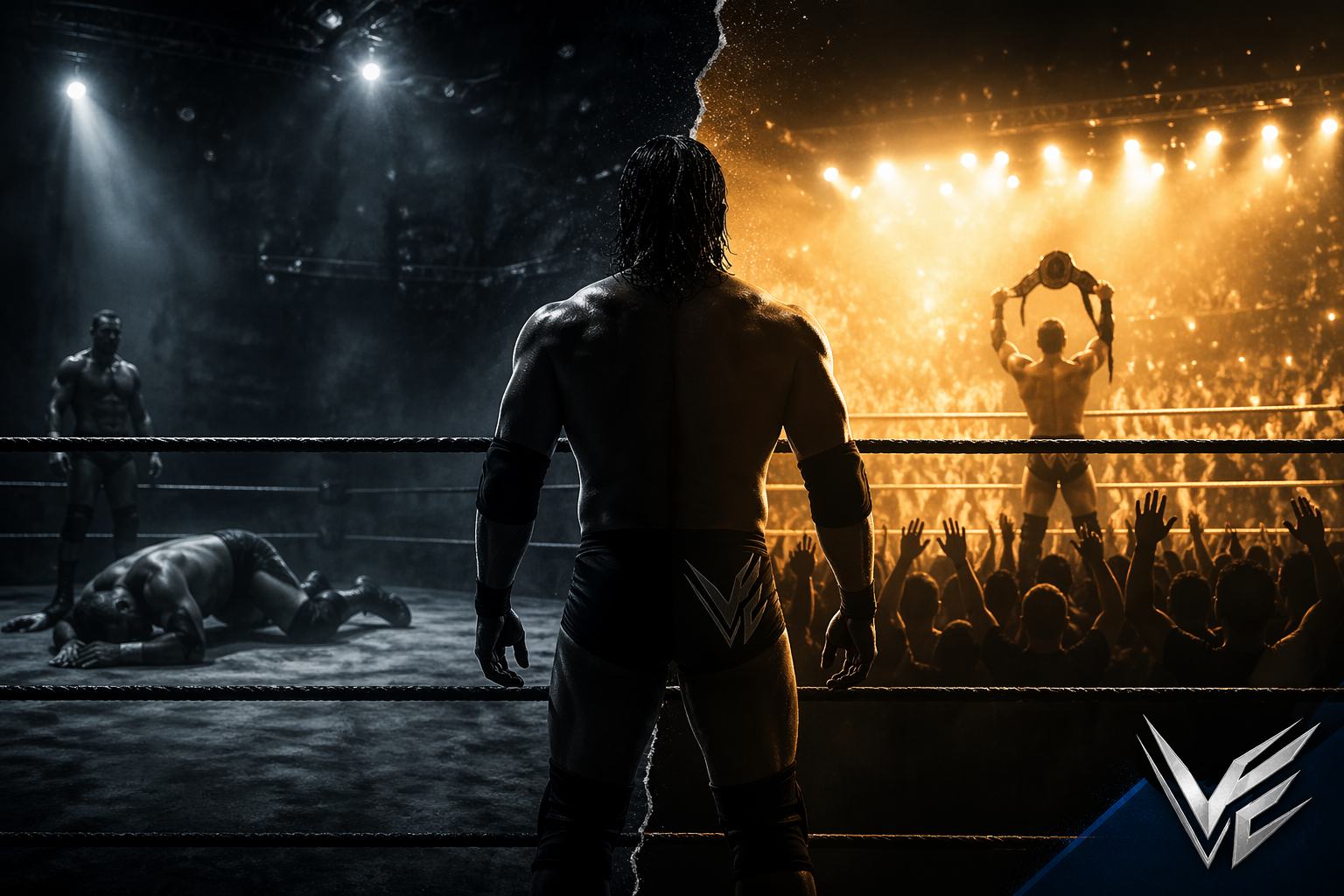
There was a time—whether people want to admit it or not—when fantasy wrestling felt like a competition.
Not a perfectly fair one. Not always a clean one. But a competition nonetheless.
You wrote to win. You structured your promos to outthink your opponent. You studied their tendencies, anticipated their angles, and tried to beat them—not just in effort, but in execution. Wins mattered because losses hurt. Championships meant something because not everyone could hold them. Momentum wasn’t handed out—it was earned, protected, and sometimes brutally taken away.
And somewhere along the way, that version of the game quietly disappeared.
What we have now still looks like competition. There are rankings. Titles. Records. Match results posted like box scores. On the surface, it resembles the same game many of us grew up playing. But once you step inside it, the illusion starts to crack.
Because today’s fantasy wrestling isn’t built to produce winners and losers.
It’s built to protect everyone.
The Death of Losing
The most obvious shift is also the most important: losing doesn’t mean what it used to.
In the past, a loss was a setback. It forced adjustment. It created tension. It separated tiers of talent. If you lost consistently, you felt it—both in how you were booked and how others interacted with your character. That pressure created stakes, and those stakes created investment.
Today, losing is often just another form of winning.
“Looks strong in defeat.”
“Protected finish.”
“Could have gone either way.”
“Interference changes everything.”
These aren’t rare outcomes anymore—they’re the default safety net.
Modern efeds have become so concerned with keeping everyone viable, everyone relevant, everyone happy, that the concept of a definitive loss has been softened to the point of near irrelevance. Characters bounce back instantly. Momentum resets weekly. Nobody falls far enough to feel like they’re truly chasing something again.
And if nobody is ever truly set back, then nobody is truly advancing either.
You can’t have meaningful wins without meaningful losses. One cannot exist without the other. But the current structure tries to preserve one while eliminating the consequences of the other—and the result is a game where outcomes feel less like turning points and more like placeholders.
The Main Character Problem
Layered on top of this is something even more subtle: everyone is writing like they are the center of the universe.
And to be clear, this isn’t a criticism of effort. It’s a byproduct of how the game has evolved.
Modern promo culture encourages big moments, big voices, and strong identity. That’s a good thing in isolation. But when every handler approaches the game with the same mindset—my character is the story—you lose something critical: shared space.
Older efeds, especially those rooted in roleplay competition, naturally created hierarchy. Not everyone was at the top. Not everyone was framed as dominant. And because of that, stories had shape. There were rises, falls, rebuilds, and long-term arcs that required patience.
Now, that hierarchy is often flattened.
Everyone is dangerous. Everyone is elite. Everyone is one win away from a title. Everyone is presented as if they should be the focal point. And while that sounds appealing, it creates a strange contradiction—if everyone is the main character, then no one actually is.
The result is a roster full of leads with no supporting cast.
And without contrast, without levels, without space to climb, the idea of “progress” starts to feel hollow.
Booking vs. Ego Management
This is where things get uncomfortable.
Because the shift away from hard competition hasn’t just changed how handlers write—it’s changed how shows are built.
Booking used to be about direction. You had a vision, a hierarchy, and a willingness to make decisions that wouldn’t please everyone. That tension was part of the ecosystem. Not everyone agreed, but everyone understood the stakes.
Now, many environments lean toward something else entirely: balance through preservation.
Matches are structured to avoid damage. Results are framed to keep doors open. Long-term plans are adjusted to accommodate reactions. Instead of booking outcomes that define the landscape, shows are often designed to maintain it.
And to be fair, there’s a reason for that.
Retention matters. Community matters. Nobody wants to lose good writers because of a bad stretch. But in solving for that, many feds have unintentionally replaced competitive integrity with emotional management.
It’s not about who should win anymore.
It’s about who can afford to lose.
The Myth of Fair Judging
If competition still exists anywhere in the modern game, it’s in judged formats.
But even there, things aren’t as clear as they used to be.
Judging was never perfect. It always carried bias, interpretation, and subjectivity. But it had one defining characteristic: it was accepted as the deciding mechanism.
Now, even that feels uncertain.
Word count debates overshadow structure. Style preference bleeds into scoring. Established names carry weight—whether consciously or not. Feedback becomes softer, less direct, more diplomatic.
And the biggest shift of all?
Judging is no longer just about determining a winner. It’s about justifying one.
That difference matters.
Because when a system spends more time explaining outcomes than enforcing them, it signals something important: the result isn’t universally trusted to stand on its own.
A Multiplayer Game Played Solo
At its core, fantasy wrestling has always been a collaborative medium.
Even in competitive formats, you needed your opponent. You needed the world around you. You needed stories that extended beyond your own character to give your work context and meaning.
But the modern approach often flips that dynamic.
Handlers write in isolation. Promos are crafted as standalone pieces rather than responses. Interaction is minimized unless it serves a specific purpose. The shared world becomes background noise instead of an active component.
It’s a multiplayer game being played with a single-player mindset.
And when that happens, the entire structure shifts.
Wins don’t feel like victories over someone—they feel like validations of yourself. Losses don’t feel like setbacks—they feel like miscalculations. The opponent becomes secondary. The story becomes internal.
Which brings us back to the central question:
If you’re not truly competing with the person across from you… what are you actually playing?
So… Are We Still Playing the Same Game?
That’s the question this all circles back to.
Because this isn’t about saying the modern version of fantasy wrestling is worse. In many ways, it’s more creative, more inclusive, and more accessible than it has ever been. The writing quality is higher. The presentation is stronger. The barriers to entry are lower.
But it is different.
Fundamentally different.
What used to be a competitive structure with collaborative elements has become a collaborative structure with competitive aesthetics. The look of the game hasn’t changed—but the function has.
And maybe that’s fine.
Maybe this is just evolution. Maybe the old model—hard losses, strict hierarchy, unforgiving booking—doesn’t fit the community-driven environment that exists today. Maybe the shift toward protection and balance is what allows the game to survive.
But if that’s the case, then it’s worth being honest about it.
Because calling something competitive doesn’t make it so.
And pretending nothing has changed doesn’t preserve what once was.
Final Thought
The illusion of competition isn’t necessarily a problem.
But it is a reality.
And the more clearly we see it, the better we can decide what we actually want this game to be moving forward.
Do we want true competition, with all the risk and consequence that comes with it?
Or do we want collaborative storytelling that wears competition as a familiar skin?
Right now, we’re trying to have both.
And that might be the biggest illusion of all.


