
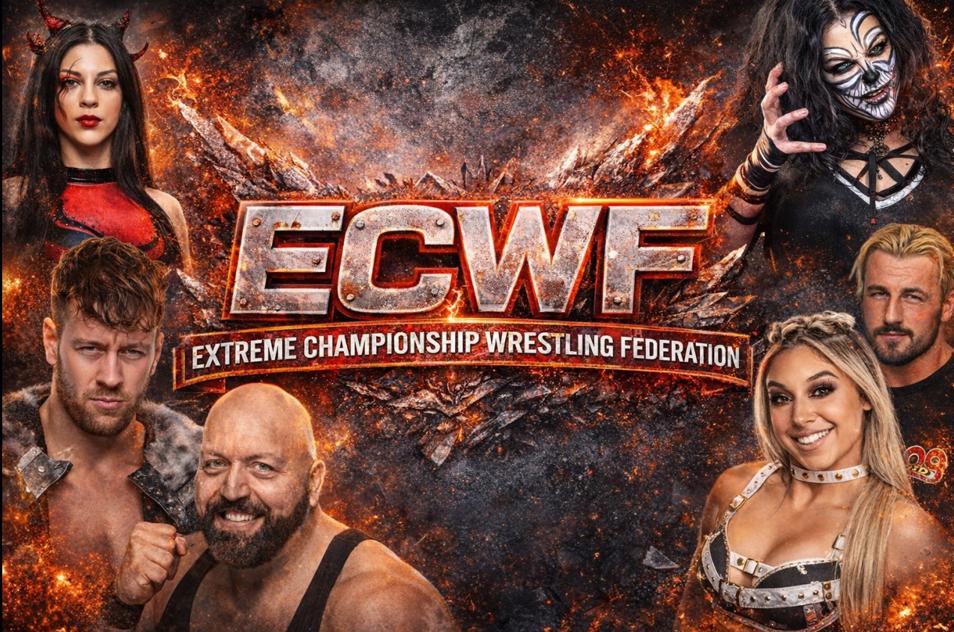
ECWF’s MAYHEM Episode 40 is a strong road-to-StarrCade show built on momentum, spectacle, and just enough violence to make the whole thing feel unstable in the right ways.
RESULTS: https://ecwf4ever.proboards.com/thread/16370/mayhem-episode-40
This is not a polished, straight-line wrestling show. It is a show full of ominous returns, theatrical chaos, creepy champions, dirty finishes, backstage declarations, and one completely unhinged title stipulation reveal. What makes it work is that ECWF never loses control of it. Even when the show gets weird, it still feels like it is moving with purpose.
That is the biggest strength of this episode. Almost everything on it matters to something bigger. John Blackheart returns and instantly gets tied to StarrCade. Rory Ironheart keeps her momentum going. The Family feud gets more absurd and more personal at the same time. Vin Halsted and KD Feigel survive a war. TJ Alexander and Jacob Striker get pushed into uglier territory. Jack Silverman pushes Sammy the Creep to the limit. SYNN gets handed a StarrCade title match so over-the-top that it should be ridiculous, yet somehow still feels like it belongs on this show.
The opening return for John “Enforcer” Blackheart was exactly what a return match like this should be. It was not about suspense. It was not about whether Stan Steve could pull off the upset. It was about making Blackheart feel like a serious presence again, and ECWF handled that well from the start. The entrance was big, Diana Blackheart helped complete the act, and once the match started, Blackheart looked like somebody who had not come back to ease his way into anything.
Stan got enough in to show some fight, but this was Blackheart’s segment the entire way through. The shove, the no-selling, the flying clothesline, Snake Eyes, the big boot, and then the Tombstone all made the point clearly. This was a return built around dominance, and it worked because ECWF did not try to overcomplicate it. Even better, the later backstage segment with VANTAGE and Dr. Octavia Kane gave the return an immediate direction. Blackheart was not just back. He was already pointed at something important.
The vignette for A Native Americano was another smart piece of buildup because it had its own identity without dragging the show off course. ECWF does a lot with presentation, and this fit right into that. The dusty imagery, the talk about having been a boss and a ghost, and then the line about being back to being a problem all gave the impression of somebody who is not being introduced as a project. He is being introduced as a threat. That is the right approach for a hype package like this.
Rory Ironheart versus Beretta Blade was one of the better pure matches on the card because it stayed focused on what both women do well. Beretta brought speed and flash, Rory brought force and timing, and the match moved with a nice pace without trying to turn itself into a giant epic. Beretta still feels like someone with upside, but Rory felt like the more complete wrestler, which is exactly how this should have come off.
The small package finish worked because it fit the rhythm of the match. Rory did not win by overwhelming Beretta. She won by adjusting faster in a scramble. That makes her look sharp rather than just lucky, and it lets Beretta keep some value in the loss. Matches like this are useful because they help define where people are on the ladder without making that hierarchy feel forced.
The Family wedding segment was one of the most memorable things on the episode because it fully embraced wrestling absurdity without falling apart. The twisted chapel setup, Sammy the Creep throwing black rose petals, Mr. Sinner running the ceremony, Melizza in the gothic wedding dress, and The Giver grinning his way through the whole thing all made this feel like ECWF leaning hard into one of its stranger corners. The key is that everybody committed to it. Nobody played it halfway.
Then Rory and Rafe crashing the ceremony gave it the exact jolt it needed. Once the fighting started, the segment stopped being just spectacle and became a real extension of the feud. Melizza getting shoved face-first into the cake was the payoff visual, and it was a good one because it was funny, humiliating, and still did not make The Family feel weak. If anything, it made the whole situation feel even more unstable. This was ridiculous, but it was the right kind of ridiculous.
The Lucha Ascension material did its job, but it was one of the less impactful parts of the show overall. The interview with Brooke and the Mavericks at ringside gave the division some added context, and Dirty Dragón winning the three-way the way he did made sense. The eye rake, the loaded elbow, the tights on the pin, and the stare down with Diego Alejandro Matias all fit the character and set up more tension moving forward.
Still, on a show with this many louder moments, this section felt more like connective tissue than a standout feature. There was nothing wrong with it, but it did not hit with the same force as some of the stronger matches and angles elsewhere on the card.
The backstage segment with VANTAGE and Dr. Octavia Kane was a good example of ECWF using atmosphere to make a straightforward booking development feel bigger. The flickering lights, the distorted timing, Kane’s language about threads fraying and time thinning, all of that keeps the act feeling distinct from the rest of the show. Then Stephen Grant naming Blackheart as the StarrCade challenger gave the segment a clean purpose. It tied one of the show’s biggest returns directly into one of the bigger matches on the horizon, and that is exactly what a segment like this should do.
Vin Halsted and KD Feigel versus Il Monstro Oscuro and The Giver in the No DQ, No Countout, Falls Count Anywhere rematch delivered the kind of chaos the stipulation promised. This was not a match built around elegance or pacing in the traditional sense. It was built around escalation. Trash cans, tables, ringside brawling, stage fighting, and bodies crashing through things all felt like natural extensions of the rivalry rather than random hardcore filler.
The biggest thing this match had going for it is that it kept building. Halsted’s powerbomb through the table, the moonsault off the barricade, and then the Fahgetaboutit Bomb off the stage through equipment all gave the match the kind of visual progression it needed. KD Feigel getting the pin on The Giver with Kaos Theory also gave the whole thing an actual payoff instead of just ending on a pile of bodies. This was a fight, not just a spot reel, and that helped it.
TJ Alexander versus Caine Marik was one of the better examples on the show of a match that worked both on its own and as a vehicle for a larger angle. These two have enough history that the match already had something behind it before Jacob Striker ever got involved. Caine brought power and nastiness, TJ brought movement and counters, and the match had a little more edge because they felt like two guys who knew exactly what the other one could do.
Then Striker arrived and shifted the whole thing. The running elbow, the suplexes, the mic work, and especially the Tiger Driver on the apron all made the segment feel cruel in the right way. The line about meeting at StarrCade in a battle without honor or humanity was exactly the kind of escalation this feud needed. TJ rolling Caine up for the win afterward was also the right call. It let TJ survive, let Caine keep his credibility, and made Striker the real takeaway. That is useful chaos. ECWF got a lot out of that segment.
Jack Silverman versus Sammy the Creep for the ECWF Television Championship was probably the best overall match on the show. It had urgency from the start, it had a clear style clash, and it had enough near-falls and momentum swings to feel like a real title match rather than just another TV defense. Silverman looked like a calculated killer. Sammy looked like the same unpredictable nightmare he always does. That contrast gave the match its identity.
The Canadian Destroyer was a strong near-fall, Silverman’s striking and submissions kept the pressure on, and the time-limit draw was one of the better finishes on the show because it felt frustrating in the right way. Silverman had him. The bell saved Sammy. That is all the audience needs to understand. Then ECWF immediately doing the no-time-limit rematch announcement for StarrCade was exactly the right move. It turned the draw into something productive instead of just controversial.
The Heavyweight Championship contract signing was the biggest spectacle on the show and probably the clearest example of ECWF knowing exactly how far it wants to push its own world. SYNN continues to feel like one of the promotion’s strongest acts because everything about her presentation stays consistent. The entrance, the body language, the pauses, the way she speaks when she finally does speak — all of it matters.
Jacob Striker showing up to make his case before the contract signing added a little extra tension without hijacking the segment, which helped. But the real turn came when Michael Maddox appeared on screen with Kevin Hunter’s signed contract and introduced the Three Stages in Hell stipulation. A triple-stacked cage, a ring of fire, the title above the third cage, and the winner needing to escape and set the opponent on fire before retrieving the belt is complete fantasy wrestling insanity. The reason it worked here is because ECWF did not flinch. It presented the stipulation like a nightmare and then let SYNN’s promo afterward make it feel personal.
That was the real selling point. More than the giant cages or the fire, it was SYNN talking about dragging Kevin Hunter into Hell that made the whole thing land. The stipulation is the spectacle. The promo gave it teeth.
The final women’s title direction with Rachel Hyde and Felicia Atherton did what it needed to do, though it did not hit with quite the same force as some of the other StarrCade developments on the show. Felicia stepping out, making the title motion, and Rachel staring her down is a clean and easy way to set the direction. It worked. It just came after bigger and louder segments, so it felt a little more functional than memorable.
Three Things I Really Liked
1. John Blackheart’s return had immediate purpose
He did not just come back to exist. He came back, looked dominant, and then instantly got tied to VANTAGE and StarrCade. That is how a return should work.
2. The show kept building StarrCade in multiple directions
The Television Title match, the Blackheart-VANTAGE development, TJ and Striker, the Heavyweight Title segment, and the women’s title setup all gave the bigger show more shape.
3. The Family wedding segment was ridiculous in a way that actually helped the feud
It was memorable, committed, and gave the feud another layer instead of just existing as random comedy.
Three Things I Didn’t Like or Found Confusing
1. The Lucha Ascension portion did not stand out enough
It had some useful story movement, but on a show this full, it felt easier to forget than some of the stronger matches and angles.
2. Some of the biggest highs came from segments more than matches
That is not always a bad thing, but this was definitely a more angle-driven episode than a match-driven one.
3. The final Rachel Hyde and Felicia Atherton setup felt more functional than hot
It established the title direction clearly, but it did not have quite the same energy as the bigger StarrCade build elsewhere on the show.
Final Thoughts
MAYHEM 40 succeeds because it feels like a show that knows where it is going. It is not trying to make every match feel like the biggest thing on the card. It is trying to make StarrCade feel bigger by the end of the night, and it mostly accomplishes that. Blackheart is back and already relevant. Rory Ironheart keeps moving upward. The Family feud got stranger and meaner. Halsted and Feigel survived a war. TJ Alexander now has something uglier waiting for him at StarrCade. Silverman proved Sammy the Creep can be pushed. And SYNN now heads into a title defense that feels every bit as over-the-top as her character should be able to survive.
That is a lot to get done on one episode, but ECWF handled most of it well.
By: Collin Voss
Collin Voss covers weekly fantasy wrestling programming with a focus on character progression, match psychology, and overall show structure.


